Monday, 13 December 2010

Game review excerpt

This is the second version of the review. Please ignore any spelling/grammar errors if you read this, im leaving the final spell/grammar check until I have a final version.


Space Invaders was released in 1978 and despite being 32 years old at the time of writing this, it is still as popular as it ever was. Well maybe I’m exaggerating a bit, but nonetheless it still holds a special place in many gamers’ hearts. Sadly, I was born in 1990 and as such was unable to experience the impact that this game had. The game was especially popular in Japan where arcades devoted there entire floor space to Space Invaders machines. Clearly it was a smash hit for the developers (Taito Corporation) and many view Space Invaders as the game that brought gaming into the mainstream, revolutionizing the industry itself.
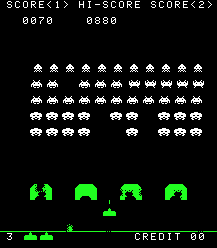
As with many “retro” games, the game itself was fairly simple. The player controlled a laser cannon which could be moved across the bottom of the screen, and it was their job to defeat the approaching aliens by shooting them. Defeating each alien would earn the player a small amount of points but it would also increase the speed that the aliens approached the player. If the aliens reached the bottom of the screen, it was game over. The player was also able to use the blocks at the bottom of the screen to shield themselves from enemy fire, these can be destroyed by the aliens if they took too many hits.

In Chris Crawfords book The Art of Computer Games Design (1982) he says that games are dynamic and change with the players actions, as opposed to a puzzle which are static and can only be solved in one way. For a simple game like space invaders, there are a surprising numbers of decisions to be made by the player. For example, do I just kill one layer at a time, or do I kill whichever is closest, do I stay in the open and risk dying, or do I hide behind the shields and risk losing the cover that the shields will provide. These decisions can alter the game state and dictate how the remainder of the game is played. This also makes it more than just a puzzle, it makes the game dynamic and requires the player to make critical decisions and ultimately rewards them with a great sense of achievement.

This sense of achievement is provided by the Mechanics, Dynamics and Aesthetics of the game which Robin Hunicke, Marc LeBlanc and Robert Zubek talk about in there article A Formal Approach to Game Design and Game Research. These terms are defined as followed:

  • Mechanics: Game components
  • Dynamics: Behaviour of mechanics acting on player inputs
  • Aesthetics: Desired response from the consumer
They believe that all games have various aesthetic elements to them that make them "fun". These elements have been defined in this article as being:

Sensation: Game as sense of pleasure
Fantasy: Game as make-believe
Narrative: Game as Drama
Challenge: Game as obstacle course
Fellowship: Game as social Framework
Discovery: Game as uncharted territory
Expression: Game as self discovery
Submission: Game as pastime

The most prevalent of these in Space Invaders is Challenge, with very little emphasis on the other elements. However, the authors do state that not all games will need to include every element in the taxonomy to be considered “fun”. A challenge can be created by many things, competition and obstacles are two things which Costikyan lists as good mechanics to create challenge. However, the challenge in Space Invaders comes from the decision making I mentioned earlier and the increase in difficulty as you progress. These would be considered the game mechanics.
The sense of achievement that the player experiences when they pass through each level would be considered the game aesthetics.

I believe that Space Invaders is a prime example of a game that has focused mainly on one of these elements and has been extremely successful it’s in implementation.

Another aspect of Space invaders which was executed well was the tension that the game creates.

““Tension” is the perceived danger that a player might become the weakest side on the conflict, while “Threat” is the actual power of the opposing forces on the conflict” – Venturelli, 2009

As I mentioned earlier, when an enemy is killed, the music and speed of the enemy increases. This may seem like a small change, however, the amount of tension it creates its enormous. The danger you perceived at the beginning of the game increases dramatically. The amount of threat certainly decreases as you kill enemies, but this only serves to create more tension. This means that the tension is sustained throughout the game, even though the player may eventually achieve an easy victory.

As with a lot of retro games however, the challenge aspect is often overdone.

“Computer and console game developers are constantly grappling with
the notion of struggle; they know that if the game is too hard, players
will find it frustrating. Contrariwise, if it is too easy, they will find it dull.”
Costikyan, 2004

In the context of Space Invaders I would have to agree with Costikyan. Space Invaders is very difficult game to complete, even more difficult is completing it with a high score. In the modern day I don’t believe this game would have been so successful. This is because a lot of gamers nowadays are casual gamers, they don’t have time nor do they want to play fiendishly difficult games.

“Players log on to their profiles on a range of social networks and can play games which include managing a football team to cultivating a farm. The games are quick to access, easy to play, and crucially, most are free to start.” - Kristian Segerstrale, 2010

They want games that they can play for a short while, socialise with friends and before they quit, they want to be able to save there progress and continue when they return. These are features which Space Invaders sadly lacks. The devlopers were not even kind enough to include level codes; a popular method retro games used to allow the player to continue from where they left off.

However, when Space Invaders was released, it was an arcade game. This means that people at the arcade had plenty of time to kill and it was also a social event, which meant that you could compete with your friends for high scores, further increasing the challenge aspect of the game. Because it was a social event, it also meant that the frustration of “losing” was muted somewhat by the competition aspect. When a group of friends went on a day out to the arcades the game was no longer about beating the game; it was about beating your friends high score.

The competition would also give more purpose to playing the game.

“A game’s structure creates its own meanings. The meaning grows
out of the structure; it is caused by the structure; it is endogenous to the
structure”. – Costikyan 2004

What Costikyan is saying here is that game objects often have no real world meaning. He offers monopoly as an example, stating that if someone handed you some monopoly money in the street, it would be worthless. The same could be said for Space Invaders. The player struggles to get the highest score possible in the game, but why? These points are worthless in the real world, they can’t be used or traded in for anything. However, if you wanted to show your friend how much better you are at Space Invaders than they are, suddenly the points do have meaning, i.e., the game has meaning.

“The rise in social gaming has piggybacked off social networks, particularly Facebook, which have seen an explosion in interest.” - Kristian Segerstrale, 2010

The social competition aspect of games has been ignored for quite some time in the gaming industry, but in the past few years many companies have seen what a powerful tool it can be. Many of the old Arcade games like Space Invaders probably owe some of there success to the social aspect of it.


Bibliography

Greg CostikyanI have no words, I must design (2004)

Chris Crawford, The Art of Computer Games Design, (1982)

Mark Venturelli, Space of Possibility and Pacing in Casual Game Design - A PopCap Case Study (2009)

Robin Hunicke, Marc LeBlanc, Robert Zubek , MDA: A Formal Approach to Game Design and Game Research, (2002)

Kristian Segerstrale, Face of the social gaming revolution (2010)

Thursday, 9 December 2010

Retro Game review excerpt

Somehow ive just managed to delete this post while i was posting the second version. Must have been on edit, instead of new post... ugh. It was basically my game review, minus some editing and minus about 750 words.

Sunday, 14 November 2010


Don't Be a Vidiot  

By Greg Costikyan
This article was actually a speech Costikyan gave in 1999. And in it he talks about what computer game designers can learn from non-electronic games. Judging by the introduction, its easy to see that Costikyan is displeases, to put it mildly, about the state of the computer games industry.


"When you look at our industry, it's easy to get worried about the enormous
number of dull, derivative titles, and the paucity of innovation in a field that
 was once known for originality and creativity. The best-seller lists are filled
 with licensed drivel--Barbie titles, games based on old mass-market boardgames."

And i see his point, to certain extent, though I believe he is over reacting slightly, there are still a large number of excellent games being released from big budget, indie and small scale developers. However, to find these games you do have to wade through a large amount of clones and rehashes. I'm not a fan of these types of games either, but if they sell in the large amounts that they do, they are obviously popular with a lot of people, so I find it difficult to criticize them too much, but that doesnt mean i want to play them either. For some people, these games are enough, even if they are paying more for better graphics, but essentially the same game.

He then goes on to say that games are a "plastic" medium and are a vague concept. By this he means that games can be moulded into whatever form you want. There are so many different genre's, types etc, and for this reason he is disappointed that game developers would rather go with the tried and tested formulas instead of thinking outside of the box and trying something new. He puts this down to the fact that the finacially safe option is more attractive to the developers.

He then talks about boardgames/card games points out various things that they have in there favour, and things that can be learnt from them:

· Social: You can play them with a group of people and even make a social event out of them
· Cheap: They are cheap to create for developers, and they can play around with various design ideas without spending a lot of money. This can result in a varied experiance for the consumer. Even though they are cheap to develop they can still be quite expensive for the consumer though, for example, buying Warhammer models can set you back quite alot, as can buying new cards for your Magic deck.
· Variety: There are many different types of boardgames
· Replayability: They can be played over and over again and your experiance will be different.


Although the boardgame market is quite small in most parts of the world, he claims that Germany has a far larger and more competetive market for board games and the most exciting products are currently being produced in there, as opposed to places like America where the demand is not as high as it once was.


MDA: A Formal Approach to Game Design and Game Research.

This paper takes a more formal view on game design and and lays out various frameworks and guidelines that game designers should keep in mind when creating a game. Probably the most important of which was the MDA framework. To understand this framework, you would first need to know what MDA means.

Mechanics: Game components
Dynamics: Behaviour of mechanics acting on player inputs
Aesthetics: Desired response from the consumer

 The framework shows you that the game designer and consumer view games from a completely different angle. I had never thought about it this way, but i can see how different their perspectives would be, as you can see from thge image below.


As you can see, the designer views the game from the Mechanics, Design, Asthetics angle, and the consumers experiance of the game will the viewed the other way.

Aesthetic components
All games have various elements to them that make them "fun". These elements have been defined in this article as being:


  • Sensation: Game as sense of pleasure
  • Fantasy: Game as make-believe
  • Narrative: Game as Drama
  • Challenge: Game as obstacle course
  • Fellowship: Game as social Framework
  • Discovery: Game as uncharted territory
  • Expression: Game as self discovery
  • Submission: Game as pastime


However, it is important to note that not all games will have every one of these elements, in fact, having all of the elements would probably make for an incredibly confusing game. Instead, games incorporate a combination of elements and try and make them work well together.

For example, and game like World of Warcraft would probably make use of Fantasy, Challenge, Fellowship, Discovery and Expression elements. And heres why:


  • Fantasy: The world of of Azeroth (where World of Warcraft is set) is a fictional world, with otherworldly creatures and locations.
  • Challenge: Many of the dungeons that you visit will likely pose a challenge, and will often require various tactics in order to defeat them.
  • Fellowship: Again, dungeons will require you to work together as a team.
  • Discovery: As you level your character there are new locations and new abilities to explore.
  • Expression: As your charcter advances, you will obviously want to show of your fancy armour you've aquired.


This is probably the text i enjoyed reading the most, because as a gamer, its the kind of think you dont often think about, but is very interesting to read about nonetheless.

Friday, 29 October 2010

Zotero and Bibliographies

Not entirely sure whether i have done this correctly or not, but i had a go with Zotero and heres what i came up with.

Books
Maw-Ding, J. (1982) Transactions of the American Mathematical Society. 2nd ed. American Mathematical Society.

Braithwaite, B. & Schreiber, I. (2009) Challengess for game designers. Course Technology PTR. 


Articles

Zyda, M. (2009) Computer Science in the Conceptual Age. Communications of the ACM, 52 (12), pp.66-69

Igarashi, T. (2010) Computer Graphics for All. Communications of the ACM, 53 (7), p.71.


Contributions

Blake, M.B. & Gilbert, J.E. (2010) Black Computer Scientists in Academe: an Endangered Species? Chronicle of Higher Education, 57 (5), pp.35-37.

Jovanovic, N., Popovic, R. & Jovanovic, Z. (2009) A web-based computer network simulator. Communications of the ACM, 46 (4), p.384.

Monday, 18 October 2010

Group Project - Ideas and Iterations

We are currently creating an educational game which would appeal to children studying key stage 1. We are in a group of 5 and so far things have been developing really well. The game that we were given to design is called Missing Arrows, and currently the object of the game is to form small words by shooting down bubbles/balloons from the sky with your bow and arrow.

I say "currently", because we have been through many ideas and iterations and every aspect of the game subtly changes, or perhaps I could call it "evolves" into a more refined concept. Each day we have new ideas which work better than the previous one, or ideas which are too good not to add.

Even though this is a tiny game in comparison to the massive hits that companies like EA or Blizzard release, it still gives you an appreciation of how long game development and design can take. Having said that, Duke Nukem Forever better be amazing considering they've been developing it for roughly 14 years. Fingers crossed.

Monday, 11 October 2010

Types of games

Using various terms you are able to describe the gameplay of games in one word.

Agon: Competition
Alea: Chance.Randomness
Ilinx: Movement
Mimicry: Simulation, Makebelieve, role-play
Paidea: Play for pleasure, little/no constraints
Ludus: Constrained by rules, clear outcome

Games which offer Paidea and Ludus gameplay:
Probably one of the best modern examples of a paidea game with ludus elements is the recently released Dead Rising 2. Dead Rising 2 is essentially a sandbox zombie apocalypse game that takes place in Fortune City. Fans of the game will immediately know what i mean by "ludus" elements because it is often one of the most contriversial aspects of the game, it seems that some people love it and some people hate it. I am ofcourse talking about the dreaded "Time Limit". I am in the latter catagory. They have constructed a sandbox world that is extremely fun to explore and navigate, yet they insisnt on pushing you through the game, barely giving you time to look at your surroundings before you have to rush off in order to maintain the various time restrictive checkpoints.

Another example of a paidea game is Fallout 3. This one is much more enjoyable for me, simply because Bethesda (the makers of Fallout 3) creates games that are the definition of freedom. You are free to explore the world at your own pace, take as much time as you need and then if you choose, you can start one of the many missions and side missions that are scattered throughout the game world.

Tuesday, 5 October 2010

Keystage 1 game reviews

Game 1: Shape Lab (KS1 maths)
Game Link: http://www.bbc.co.uk/schools/ks1bitesize/numeracy/shapes/index.shtml

Interaction
Basic interaction
No meaningful influence on the game state
Little feedback on choices - Incorrect or Correct
No educational feedback - The player may not know why they got the question wrong.

Goals
Only one goal.
The player has no choice and no chance to influence how the goal is completed
The player also has no influence on how the game ends, even if they get multiple wrong answers, they will always get the same ending eventually.

Struggle
The game has no struggle because there is no life system. The player can guess as many times as they want until they get the right answer.
The game does have 3 difficulty levels, however, you can still guess until you get the right answer, with no negative side effects on every difficulty.

Structure
Linear structure.
The player only has one path they can take, which leads to the one goal i mentioned earlier.
No freedom within the structure.

Endogenous meaning
The shapes and the knowledge/education that you gain from playing the game has value in the real world. Some may argue they have even more value in the real world than they do in the game. However, if the game relied solely upon fiction, it would not be educational.

Evaluation
The game needs to provide useful feedback to the player to explain to them why they got certain questions wrong, otherwise the game will not be educational, and more of a test.
It also needs to include a point system, so that the player has motivation to get the answers correct instead of guessing and it will also encourage external competition.
And finally, it needs to provide struggle, this could be achieved by losing points when an incorrect answer is chosen.


Game 2: River Rhyming
Game Link: http://www.bbc.co.uk/schools/ks1bitesize/literacy/rhyme/index.shtml

All of the games on the key stage 1 bitesize website follow the same basic structure. They all ask a question and you will need to pick the correct answer from multiple choices. Everything i have said about the previous game also applies to this game. The only real difference in how they play, is the way they look graphically and the amount of answers you can choose from.

Thursday, 30 September 2010

An introduction to critical games studies

As an introduction to the critical games studies module, we were asked to provide an interview and also interview someone else so that we could get to know another member of our group. Below are the questions, along with the answers i gave to that interview.

What is the title of the book (fiction) you are currently reading (or the last fiction book you read)?
Fiction books do not tend to interest me as much as non-fiction. I prefer to read about real events or subjects. Having said that, I'm not really into books that much, i would much rather watch a film.

What is the title/topic of the book (non-fiction) you are currently reading (or the last non-fiction book you read)?
One of the very few books i have read was called "A child called it" which i read as part of my final project on a sociology course.

What is the last live performance (music, drama or dance) you attended?
The last performance i saw was about 2-3 weeks ago on board a cruise ship. There was a Theatre company on board which regularly performed scenes and songs from various musicals and shows.

What is the title of the last film you saw at the cinema/online or watched on DVD?
The last film i watched was called Shutter Island and it is probably the best film i have seen this year. However, i have yet to see Inception which is apparently incredible.

How often do you read a newspaper? (which one?)
Never. I tend to avoid depressing news as much as possible, which is the type of news that newspapers love to promote. I usually get my news from websites like Digg.com which tends to have a few funny and more enjoyable stories to read.

Which art gallery/museum/exhibition did you last visit?
That was probably The Science Museum in London when i was about 14.

How many hours a week do you spend playing video games?
Not as much as i once did. Currently, i rarely go over an hour of gaming a day, unless its the weekend and I've got allot of free time.

How many hours a week do you spend playing games other than video games.
Very few, less than 1 hour a week, if that.