Space Invaders was released in 1978 and despite being 32 years old at the time of writing this, it is still as popular as it ever was. Well maybe I’m exaggerating a bit, but nonetheless it still holds a special place in many gamers’ hearts. Sadly, I was born in 1990 and as such was unable to experience the impact that this game had. The game was especially popular in Japan
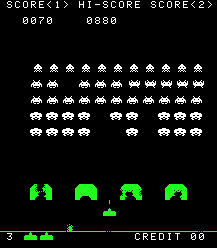 As with many “retro” games, the game itself was fairly simple. The player controlled a laser cannon which could be moved across the bottom of the screen, and it was their job to defeat the approaching aliens by shooting them. Defeating each alien would earn the player a small amount of points but it would also increase the speed that the aliens approached the player. If the aliens reached the bottom of the screen, it was game over. The player was also able to use the blocks at the bottom of the screen to shield themselves from enemy fire, these can be destroyed by the aliens if they took too many hits.
In Chris Crawfords book The Art of Computer Games Design (1982) he says that games are dynamic and change with the players actions, as opposed to a puzzle which are static and can only be solved in one way. For a simple game like space invaders, there are a surprising numbers of decisions to be made by the player. For example, do I just kill one layer at a time, or do I kill whichever is closest, do I stay in the open and risk dying, or do I hide behind the shields and risk losing the cover that the shields will provide. These decisions can alter the game state and dictate how the remainder of the game is played. This also makes it more than just a puzzle, it makes the game dynamic and requires the player to make critical decisions and ultimately rewards them with a great sense of achievement.
This sense of achievement is provided by the Mechanics, Dynamics and Aesthetics of the game which Robin Hunicke, Marc LeBlanc and Robert Zubek talk about in there article A Formal Approach to Game Design and Game Research. These terms are defined as followed:
- Mechanics: Game components
- Dynamics: Behaviour of mechanics acting on player inputs
- Aesthetics: Desired response from the consumer
They believe that all games have various aesthetic elements to them that make them "fun". These elements have been defined in this article as being:
Sensation: Game as sense of pleasure
Fantasy: Game as make-believe
Narrative: Game as Drama
Challenge: Game as obstacle course
Fellowship: Game as social Framework
Discovery: Game as uncharted territory
Expression: Game as self discovery
Submission: Game as pastime
The most prevalent of these in Space Invaders is Challenge, with very little emphasis on the other elements. However, the authors do state that not all games will need to include every element in the taxonomy to be considered “fun”. A challenge can be created by many things, competition and obstacles are two things which Costikyan lists as good mechanics to create challenge. However, the challenge in Space Invaders comes from the decision making I mentioned earlier and the increase in difficulty as you progress. These would be considered the game mechanics.
The sense of achievement that the player experiences when they pass through each level would be considered the game aesthetics.
I believe that Space Invaders is a prime example of a game that has focused mainly on one of these elements and has been extremely successful it’s in implementation.
Another aspect of Space invaders which was executed well was the tension that the game creates.
““Tension” is the perceived danger that a player might become the weakest side on the conflict, while “Threat” is the actual power of the opposing forces on the conflict” – Venturelli, 2009
As I mentioned earlier, when an enemy is killed, the music and speed of the enemy increases. This may seem like a small change, however, the amount of tension it creates its enormous. The danger you perceived at the beginning of the game increases dramatically. The amount of threat certainly decreases as you kill enemies, but this only serves to create more tension. This means that the tension is sustained throughout the game, even though the player may eventually achieve an easy victory.
As with a lot of retro games however, the challenge aspect is often overdone.
“Computer and console game developers are constantly grappling with
the notion of struggle; they know that if the game is too hard, players
will find it frustrating. Contrariwise, if it is too easy, they will find it dull.”
Costikyan, 2004
In the context of Space Invaders I would have to agree with Costikyan. Space Invaders is very difficult game to complete, even more difficult is completing it with a high score. In the modern day I don’t believe this game would have been so successful. This is because a lot of gamers nowadays are casual gamers, they don’t have time nor do they want to play fiendishly difficult games.
“Players log on to their profiles on a range of social networks and can play games which include managing a football team to cultivating a farm. The games are quick to access, easy to play, and crucially, most are free to start.” - Kristian Segerstrale, 2010
They want games that they can play for a short while, socialise with friends and before they quit, they want to be able to save there progress and continue when they return. These are features which Space Invaders sadly lacks. The devlopers were not even kind enough to include level codes; a popular method retro games used to allow the player to continue from where they left off.
However, when Space Invaders was released, it was an arcade game. This means that people at the arcade had plenty of time to kill and it was also a social event, which meant that you could compete with your friends for high scores, further increasing the challenge aspect of the game. Because it was a social event, it also meant that the frustration of “losing” was muted somewhat by the competition aspect. When a group of friends went on a day out to the arcades the game was no longer about beating the game; it was about beating your friends high score.
The competition would also give more purpose to playing the game.
“A game’s structure creates its own meanings. The meaning grows
out of the structure; it is caused by the structure; it is endogenous to the
structure”. – Costikyan 2004
What Costikyan is saying here is that game objects often have no real world meaning. He offers monopoly as an example, stating that if someone handed you some monopoly money in the street, it would be worthless. The same could be said for Space Invaders. The player struggles to get the highest score possible in the game, but why? These points are worthless in the real world, they can’t be used or traded in for anything. However, if you wanted to show your friend how much better you are at Space Invaders than they are, suddenly the points do have meaning, i.e., the game has meaning.
“The rise in social gaming has piggybacked off social networks, particularly Facebook, which have seen an explosion in interest.” - Kristian Segerstrale, 2010
The social competition aspect of games has been ignored for quite some time in the gaming industry, but in the past few years many companies have seen what a powerful tool it can be. Many of the old Arcade games like Space Invaders probably owe some of there success to the social aspect of it.
Bibliography
Greg Costikyan, I have no words, I must design (2004)
Chris Crawford, The Art of Computer Games Design, (1982)
Mark Venturelli, Space of Possibility and Pacing in Casual Game Design - A PopCap Case Study (2009)
Robin Hunicke, Marc LeBlanc, Robert Zubek , MDA: A Formal Approach to Game Design and Game Research, (2002)
Kristian Segerstrale, Face of the social gaming revolution (2010)
